Date
30 January 2026
Category
Article, Blog, Defence, Earth Observation, Security, Space
No commentsOver the last two days, we joined leading figures from the European space sector, including industry, agencies and politicians, at the 18th European Space Conference in Brussels, Belgium, to discuss the current state of the sector and future opportunities and challenges.
With the global geopolitical situation now increasingly tense, the mood carried a slightly sombre tone. Just a few years ago, discussions at this conference about defence and space were a footnote; this year, speakers talked about civilian and defence space systems in the same breath on both days, following a warning from the European Commissioner for Defence and Space, Andrius Kubilius, in his opening keynote speech that “Member States fear that war is coming”. It was no surprise, then, that common themes included dual-use civilian–military systems and the need for greater European cooperation and faster action, in particular to meet the objectives and milestones laid out in the European Commission’s Readiness Roadmap 2030.
In parallel, however, the Conference also looked forward to exciting initiatives, such as the Moonlight programme, and celebrated successes, including the start of operations of GOVSATCOM last week and the first images from Europe’s first Meteorological Infrared Sounder in geostationary orbit, MTG-S1.
Funding, disruption and innovation
Despite being delivered at the start of the Conference, the keynote speech given by the European Space Agency – ESA’s Director General, Josef Aschbacher, provides a good overview of many of the aspects presented and debated at the event. Highlighting the significantly higher spending on space by China and the US compared with Europe, he called for a doubling of European funding, disruptive, game-changing innovation, including artificial intelligence (AI) for space and quantum technologies, and “de-bureaucratisation” – the latter being echoed by many, especially industry actors, across the following 36 hours.
Josef Aschbacher also noted that “Europe is too complex, too fragmented and too difficult to navigate.” Again, he pre-empted wide-ranging discussions in which fragmentation was seen as a major risk to the increased speed needed to develop the defensive systems required by Europe and improve the resilience of other space-based services.
Later, in a panel session, Josef Aschbacher suggested that “being clever and beautiful will not succeed,” calling instead for a dynamic, agile approach, with Timo Pesonen, Director-General of DG DEFIS, promoting the concept of “incremental development with realistic but ambitious benchmarks”. Similarly, “we must avoid perfect and slow,” said one panellist, with some delegates suggesting we should build on top of existing systems for a faster result and no one disputing the need for dual-use systems to address the pressing need for robust, state-of-the-art defence systems. However, industry representatives noted that from their experience, tender processes can slow things down significantly.
Cooperation vs sovereignty
Speakers and panellists time and again acknowledged the need for European cooperation and harmonised standards balanced against systems that would both reinforce national sovereignty and promote European security. The concept of pooling and sharing was frequently mentioned as a solution along with systems of systems, while ‘security by design’ was another repeated mantra – something we at Starion have been putting into practice for many years through our system engineering capabilities and cybersecurity for space expertise.
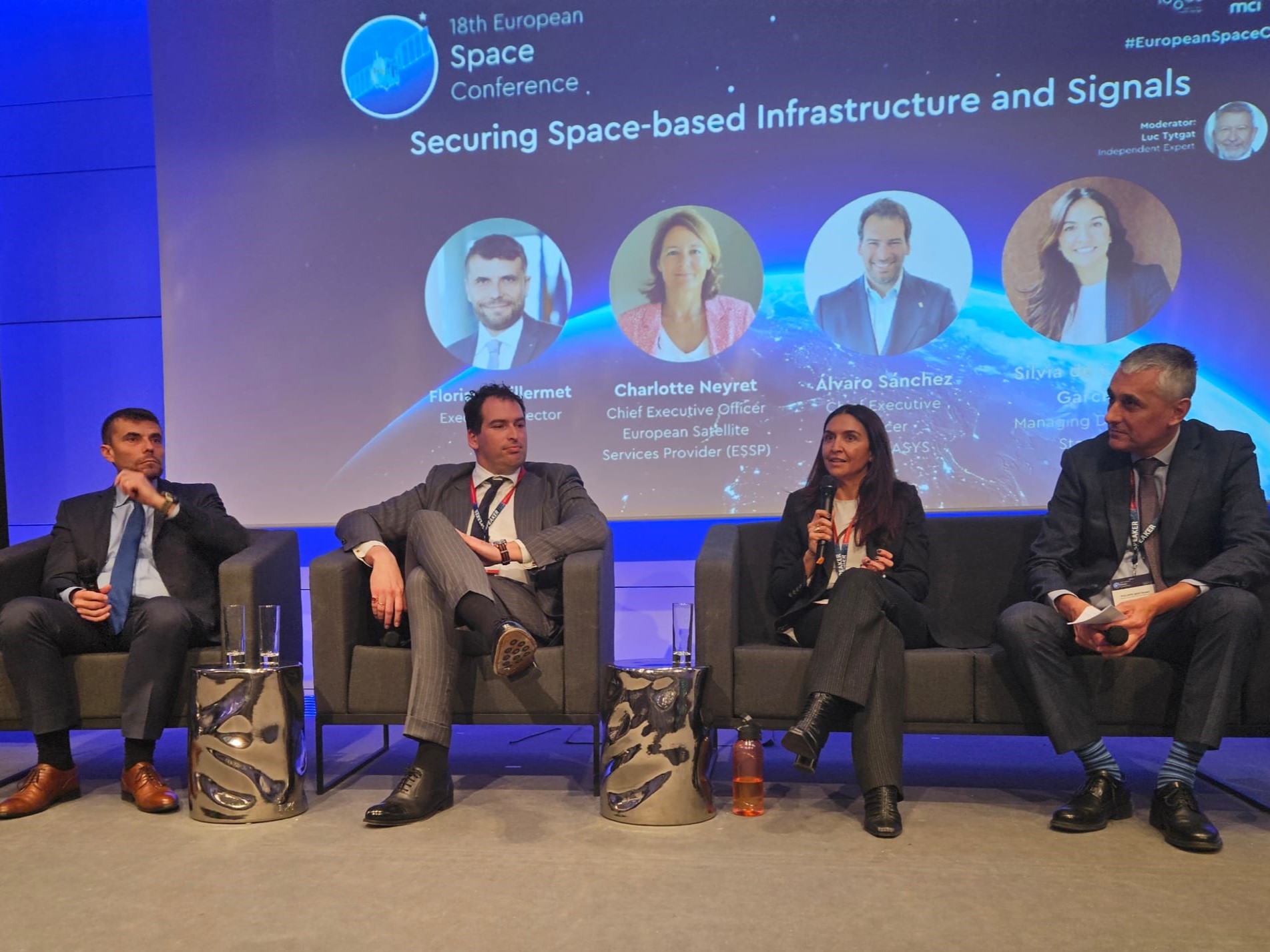
In terms of specific missions and programmes, IRIS2 was frequently mentioned across both days, with Andrius Kubilius announcing that he had asked all partners to speed up development in order to deploy initial services in 2029. There were also repeated references to the EU Space Act, the European Resilience from Space programme, the Earth Observation Government Service and the European Space Shield, the last of which is formally starting this year. The sheer breadth and scale of these and other programmes present both opportunities and challenges for those of us in the industry sphere.
Speed and success
It would have been easy to walk away from this Conference feeling overwhelmed by the scale of developments proposed and underway across the space sector, and the constant reminder that all stakeholders need to move faster, in particular to address the threat on Europe’s Eastern flank. However, along with many other SMEs, being innovative and agile is in Starion’s DNA. And we have proven capabilities in many of the fields called for throughout the Conference, such as security by design, quantum and AI for space, along with the ability to ensure user requirements are captured quickly and efficiently from the start of any project through our concurrent design and model-based system engineering (MBSE) expertise.
For that reason, we support Josef Aschbacher’s call to “use space as a means to raise the mood and energy of Europe” and “a tool to elevate the future of Europe”. The next few years will indeed be challenging, but we are excited to play our part and to see what can be achieved by the whole sector, including all the supporting stakeholders, in 2026.
Find out more
Learn more about Starion’s approach to space security.